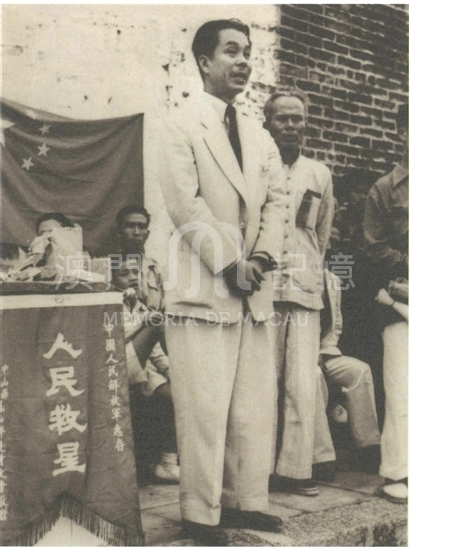
Ke Lin announcing to Macau the establishment of the PRC on 1 October 1949 (photo: macaumemory.mo)
Most travelers passing between Macau and mainland China today do so on foot through the massive Gongbei Point of Entry (拱北口岸) building, China’s customs and immigration center set on the mainland side of the line. At this gateway to Macau, “the Vegas of Asia”, you can witness how gambling and tourism combine to be the prime movers of the local economy. The facility handles thousands of people every hour of every day of the year, many of whom are there to gamble their riches away while dreaming of millions, or slyly launder money through the casinos, or engage in other related skullduggery. But there are also tourists, relatives on family visits, businesspeople, and enthusiasts of Macanese and Portuguese cuisine.
They pass by, but not under, the old Portas do Cerco, the Portuguese border gate dating from 1870. The new Chinese immigration building looms over the old gate, suggesting the breakneck pace of modern times overtaking the lazier days of yesteryear—perhaps not a coincidence of urban planning with Chinese characteristics.
Though now a mere museum piece dwarfed by its modern successor, at the end of the Cold War in 1989, the Portas do Cerco was the centerpiece of a more tranquil scene, bisected by a straight, tree-lined road that stretched north into the distance through a village and on into the Chinese countryside. On the Macau side the road became abruptly urban, flanked by apartment buildings and businesses, leading south toward the center of a busy colonial city…
…The successful preparation of Macau for China’s use during the Cold War was arguably owed one man: Dr. Ke Lin (柯麟, or O Lon in Cantonese). Though little known beyond China’s borders, Ke Lin is almost a household name in the PRC. His exploits are depicted in films, books, and television in China. In 2023-2024, the CCP even produced a modern Cantonese Opera based on his life and secret exploits which debuted in Guangdong and Beijing.
Ke Lin was originally from Guangdong Province. As a newly graduated medical doctor who joined the CCP in 1926, he was apparently an attractive recruit for the CCP’s first professional intelligence organ, the Special Services Section (SSS, 中央特别行动科, or 特科). Ke Lin’s early exploits, employing his natural cover as a physician, included baiting a trap in his Shanghai clinic to enable SSS assassins to kill an important turncoat, Bai Xin (白鑫), in 1929.
For more, see:
https://shs.cairn.info/revue-etudes-francaises-de-renseignement-et-de-cyber-2025-2-page-206?lang=fr
