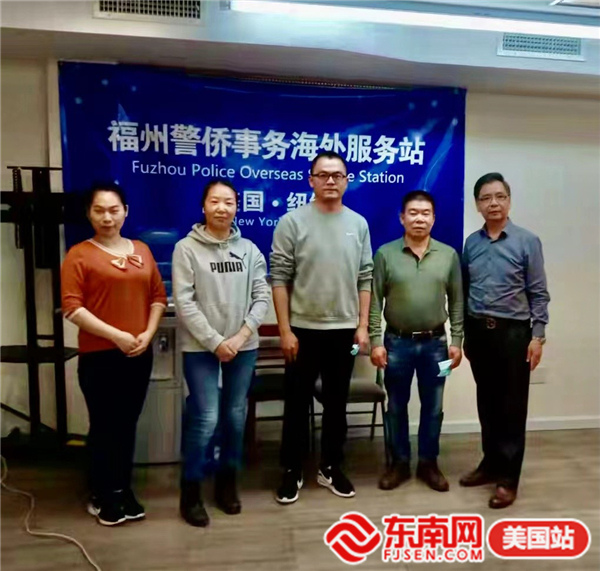
China’s semi-underground police station in New York, set up there by the Fuzhou Public Security Bureau, made headlines last month for good reason. It was completely illegal and was harassing dissidents, as well as chasing actual exiled criminals.
And there are hundreds more across the world.
For an eight-minute explanation of these stations, go here for my interview with Scott Tong on “Here and Now,” the award-winning radio program from National Public Radio and WBUR Boston. They do long-form interviews and dig deeper into contemporary affairs than other such shows, and are worth checking out.
More Details:
The Chinese Communist Party has always been a secretive organization. For their 98 million members, clandestine operations are normal. Even the headquarters building of the party’s all-important Organization Department is unmarked with standard signage.
The party is overly concerned with the slightest opposition, in part because China’s history of revolts and revolutions has many examples of fatal revolts rising from below. Whenever they find organized activity not controlled by themselves, the CCP moves to nip it in the bud. This was true before Xi Jinping rose to lead the party, and will continue after he departs the scene.
This includes Chinese dissent abroad. Party leaders no doubt remember that the father of modern China, Sun Yat-sen, did most of his organizing against the Qing Dynasty overseas before returning when the time was ripe in 1911 – as did Lenin to Russia a few years later.
So it is no surprise that the CCP takes dissent in the U.S. and elsewhere very seriously, even if it seems harmless to their powerful party-state (an important difference in perspective to keep in mind when observing CCP behavior). Thus, they have tasked the Chinese Ministry of Public Security (MPS) to have its subordinate Public Security Bureaus (PSBs) go abroad and tackle dissent, even by isolated individuals.
To be fair, the officers at these “secret police stations” also hunt for actual criminals that have committed fraud or worse. And today’s secret police stations have precedent, as shown by Matt Schrader in his January 2019 China Brief article on “Overseas Chinese Assistance Centers.”
Even older precedent: the openly established police posts in South Africa, set up beginning in 2004 for what appears to be good reasons with the agreement of the host government.
But the problem lies where such stations have been set up in secret, for reasons unacceptable to the host government, violating the 1961 Vienna Convention on Diplomatic Relations.
Research in East Asia
During the entire month of April, I was in Southeast Asia and Northeast Asia conducting research and interviews for the upcoming book. I am writing more about the findings from that trip and will send along links to articles that result.
I was particularly intrigued to find that awareness of Beijing’s worldwide espionage and influence offensive is rising more or less at the same pace overseas as it is in the United States but with less hyperbole.
In the words of Taylor Swift, we all “need to calm down” and focus on the facts.
To subscribe to my newsletter about Chinese espionage, send me an email: matthew.brazil@gmail.com
The non-communist Chinese press buzzed last week with rumors that the Chinese Communist Party (CCP) plans to reorganize its IC (intelligence community). They will allegedly merge the Ministry of State Security and the Ministry of Public Security together into a new organ directly under the CCP Central Committee.
China Times cited Ming Pao (Hong Kong) here, saying that a new super-security organ will be placed under the CCP Central Committee. The name: the “Central Internal Affairs Commission” [中央内务委员会, Zhongyang Neiwu Weiyuanhui].
That would be a commission, at the level of the Central Military Commission, NOT a higher-ranking CCP department, like the Propaganda Department and the Organization Department of the Party.
The usual Falun Gong-affiliated sources have carried the story, which also is covered on Radio Free Asia (RFA). Supposedly, this reorganization will be announced during the “two sessions” (the NPC and the CPPCC) beginning this week, on Saturday 5 March.
This sort of news is troublesome because no sources are ever cited. The information, even if completely accurate, will in any case be kept secret by the CCP until the last second.
I polled four scholars who have long studied the organs of Chinese state security. None had heard any information to confirm or refute the idea of another PRC IC reorganization. The last reorg was in 2015, creating the PLA Strategic Support Force, and before that, in 1983, when MSS was founded.
“Possible but not probable” said one. “It makes sense,” said another, since Xi Jinping seems to favor consolidation of Party control due to longstanding issues of corruption in the ranks: web search MSS former Vice Minister Ma Jian, for example.
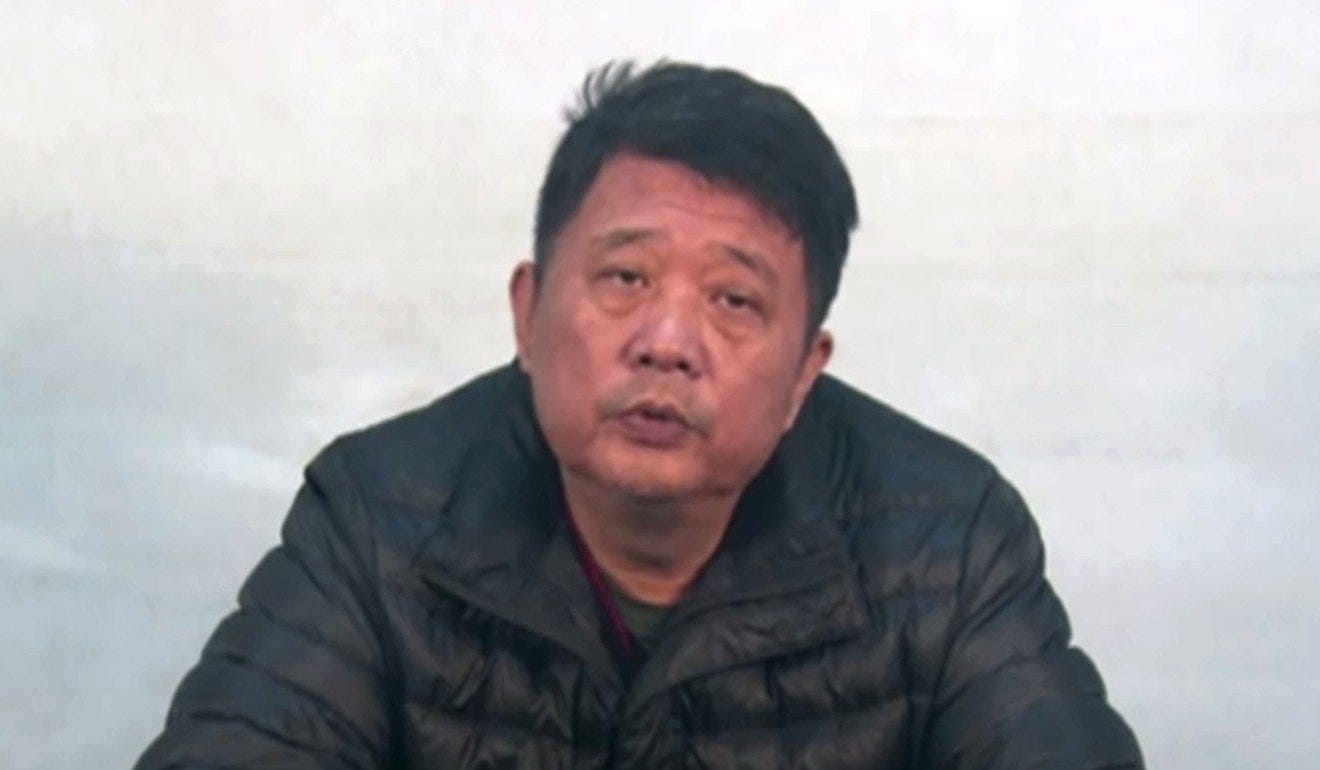
Former MSS Vice Minister Ma Jian in humble confession mode (Image: China Central Television)
Another China analyst from the Paris-based organization Intelligence Online offered a similar view. While there is no evidence that this reorganization is in the works, she said that this seems consistent with Xi Jinping’s continuing efforts to reduce the margins of “untrusted functionaries.”
For more, see the article at Spytalk.co, here, where you can find numerous pieces on China, Russia, and our very own national security state.
That Balloon (or Those Balloons)
If you’re not sick of balloonery, take a look at this piece that I recently published on SpyTalk. It attempts to assemble the important stuff about that ordeal, and also this Defense One article by my comrade Thomas Corbett at Bluepath Labs.
Speaking of American companies helping China’s defense industry, watch for an upcoming article on Defense One. It will show how the business model of certain American high-tech companies is ideal for Chinese entities trying to evade US export controls.
As always, feel free to pass information this along to any interested party. Or Party.
US firms helped build Beijing’s ubiquitous surveillance systems
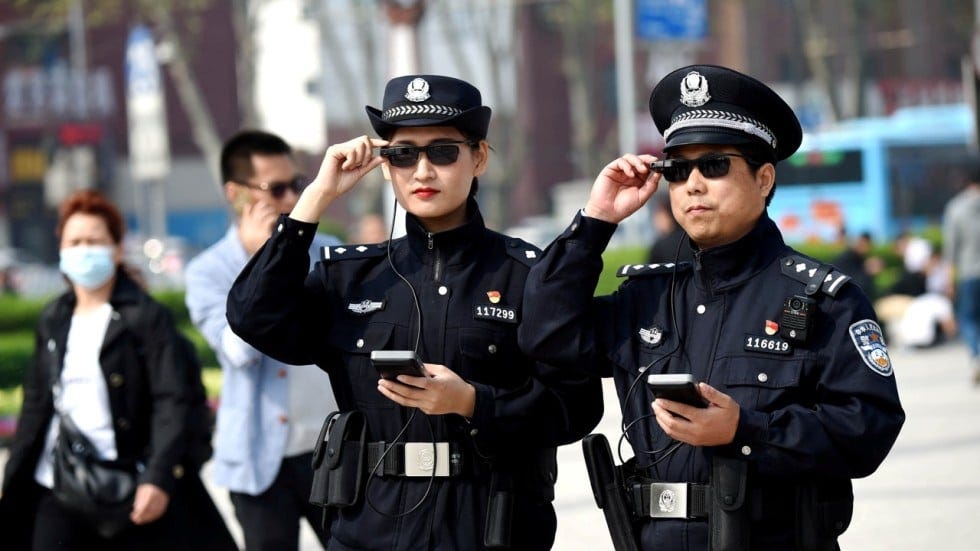
Police officers in Luoyang in Henan province wear sunglasses linked to facial recognition software that can identity fugitives. The devices are just some of the advanced surveillance technology used by police in China. Photo: Reuters via SCMP
China’s anti-lockdown protests last month were the worst blow yet to the prestige of Xi Jinping. One moment, the Chinese Communist Party’s leader was riding high after securing a third term at the top of the party-state. The next, he was challenged by demonstrators in the streets to “step down,” a sentiment that protestors also chanted against the party itself.
The discontent with the CCP expressed by demonstrators exceeded that of the more massive 1989 protests at Tiananmen Square, albeit this time with much lower numbers: most of the 19 or more cities where protests erupted drew less than 50 people, while the other half in tier one cities with more foreign contact attracted over 50, some in the hundreds.
Though the numbers were small, it was a notable “political coming out of the closet,” (政治出柜, zhengzhi chugui), much discussed in Chinese social media. But to keep it in perspective, the protests were not thousands of people openly defying authority, as the world now observes in Iran. As far as is known, these were limited actions by small groups in urban centers.
However, the protests in China at the end of November were bold, as those who participated risked arrest or worse. And there is a chance that the demonstrators represented a larger and more cautious percentage of society.
Though the party leadership rapidly (maybe too rapidly) eased the “zero Covid” restrictions that prompted this popular anger, those who spoke up soon learned who was boss.
A rough pattern of police response developed, with some similarity to the way some other protestors have been treated. Mere participants were summoned to police stations to explain themselves and sign statements saying they would never do it again. One demonstrator, perhaps typifying others, had tried to disguise himself with a balaclava and clothing change but was quickly tracked down by police. He was surprised at how easily authorities had picked him out of a large crowd, evidently using his phone data and their urban surveillance system.
Leaders of the protests were treated more harshly. At least one—the man who may have led the first “step down” chants in Shanghai—was apprehended at work and has since disappeared. He, too, thought he might not
be identified.
Years ago, well before Xi Jinping’s new era of paranoid surveillance, some citizens have been more clued in than others to the regime’s use of mobiles to keep tabs on users. Chinese citizens secretly working for a foreign intelligence agency were trained to, among other things, separate their phones from any incriminating activity.
Those just living lives removed from international intrigue, but who were tech savvy, also chose different ways to minimize surveillance, according to a Chinese American author who has regularly returned to China for research. They would “put their cell phones in another room when they talk, or take out the SIM cards, use different cell phones to contact different people,” similar to the tactics of protestors in the U.S. to avoid surveillance and police use of data.
Excerpt from “China, The Fearful Intelligence Culture,” By Matthew Brazil
The Chinese Communist Party (CCP) has placed priority on its intelligence and security operations for almost a century. This core business of the party significantly contributed to the CCP’s 1949 victory and to the maintenance of its current power.
Most recently, the internet and artificial intelligence (AI) have enabled previously unimaginable foreign espionage successes. Yet there are cracks in the façade: unending existential fear about enemies within; fear of being caught between CCP General Secretary Xi Jinping’s never-ending anti-corruption drive and a culture that still fosters graft; as well as fear of being insufficiently loyal to Xi’s “thought” and to his status as the CCP “core.”
Drawing from Chinese language publications and interviews with former western security officials who had regular contact with their Chinese counterparts, this chapter argues that these are old problems, but under Xi, have become more pronounced than in recent decades. It shows how China’s espionage organs will likely continue to achieve successes in cyber espionage, agent recruitment, and technology theft, but dispassionate intelligence analysis may be hindered by pressure to conform to the party line. Thus, Chinese intelligence culture in the 2020s may sometimes make it difficult for Beijing’s senior leaders to see the forest through the trees.
The above is an excerpt from “China: The Fearful Intelligence Culture”, in Ryan Shaffer, ed. The Handbook of Asian Intelligence Cultures (New York: Rowman & Littlefield, October 2022). This chapter on China has six sections:
The Shellshocked Roots of Chinese Communist Intelligence and Security
Corruption, Anticorruption, and Power Struggles
State Security, Not National Security
The Lasting Leftist Influence of Mao Zedong and Kang Sheng
Competent Spy Versus Rear Area Ideologue
Conclusion: Beijing’s services may be developing a superior understanding of big data compared to their Western counterparts as cyber operations garner an ever greater share of resources. Meanwhile, during the 2020s and 30s the ranks of State Security and military intelligence will fill up with recruits born during and after the 1990s, raised in an era of heightened nationalism and suspicion of foreigners. If the legacy of fear persists while raw data from cyber and other operations keeps piling up, Beijing’s ability to make sense of the outside world and future domestic developments may decline.
The Handbook of Asian Intelligence Cultures has 30 chapters, one for each Asian nation, and can be found on Rowman.com and Amazon.
The above article is also available on LinkedIn here.
Here are two very recent forums where I had opportunities to reflect on the intersection between China’s security and intelligence apparatus and the nationwide lockdown protests:
As a result of the tragedy in Urumqi, protestors in China are almost certainly motivated by the fear that they themselves might become fire, earthquake, or flood victims should they need to evacuate a locked-down location.
Secondly, if demonstrators did not previously understand the extent to which their mobile phones were miniature spies-in-the-pocket, they certainly do now. That realization could alter the way people in China handle their cell phones. Imaginative ways to circumvent the surveillance system could develop.
Finally, the protests will probably soon be suppressed. But if they continue, the next step could be to call in the People’s Armed Police (PAP), which is a different organ of state security than the Public Security Bureaus around the country. The PAP is little understood outside of China – but is an extremely powerful tool with vast resources. They are trained to quickly put down mass civil disturbances with overwhelming force, but to do so without resorting to the June Fourth, 1989 solution of machine-gunning the citizenry in the streets.
The Hoover Institution’s Dr. Michael Auslin is joined by Anna Puglisi, former National Counterintelligence Officer for China, and Matt Brazil, Senior Analyst at BluePath Labs and co-author of Chinese Communist Espionage, to discuss just how widely and successfully Chinese spies have penetrated American business, government, and academia.
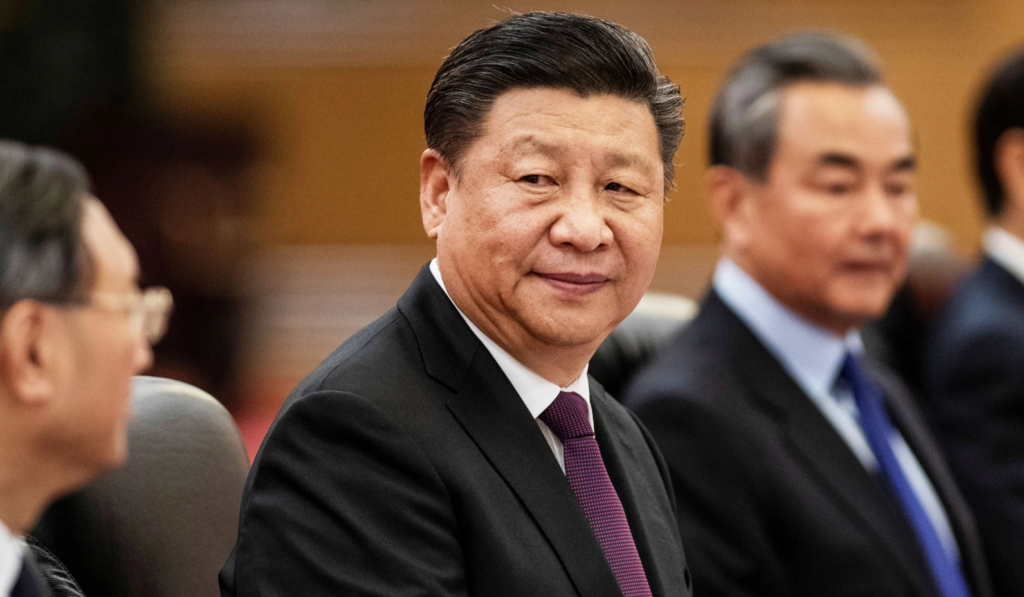
China’s President Xi Jinping at the Great Hall of the People in Beijing, December 10, 2018. (Fred Dufour/Reuters)
As Washington’s allies struggle to resist Beijing’s worldwide espionage and influence offensive, the U.S. can set an example.
hen the People’s Republic of China was founded in 1949, many in the nation remained resistant. But in the words of Mao Zedong, the Chinese Communist Party had three “magic weapons” (法宝, fǎbǎo): a well-organized military, party building, and its United Front apparatus, now known as the United Front Work Department (UFWD). In part by stressing consensus and mischaracterizing their long-term plans, United Front cadres convinced influential figures to support the new government. Meanwhile, the People’s Liberation Army (PLA) mopped up remnant Nationalist units, invaded Xinjiang and Tibet, and intervened in Korea.
The chairman avoided publicly praising a fourth magic weapon: his espionage apparatus, then called the CCP Social Affairs Department (社会部, Shèhuì bù, SHB). From 1946 to 1949, SHB spy rings thoroughly infiltrated the Nationalist Party, army, and government. As Generalissimo Chiang Kai-shek later reportedly said, “there was no space that they did not enter” (无孔不入, wú kǒng bùrù).
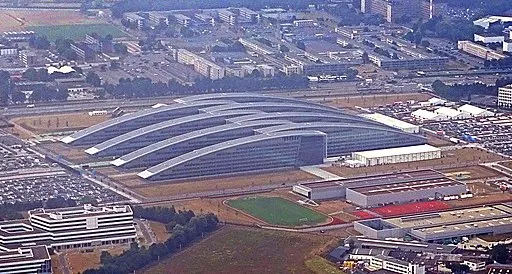
Supreme Headquarters Allied Powers Europe (SHAPE) in Brussels (Credit; Wikimedia Commons)
Conjure up a list of cities considered world capitals of espionage. Those featured in movies and television, with their romantic atmosphere and scenery, include Vienna, Budapest, Berlin, London, Cairo, Tokyo, Shanghai, Hong Kong, Macau, Bangkok, and Saigon.
Not to ignore the less romantic but important cities of Moscow, Beijing, and Washington, DC.
By comparison, Brussels seems overlooked by spy novelists and film directors, but its unusual concentration of diplomatic missions to the European Union, NATO, and to Belgium itself brings a high ratio per square kilometer of diplomats and lobbyists—as well as spies. “Washington and Brussels compete for the largest number of embassies and other representations on earth” remarked an ICT (information and communications technology) executive close to the Belgian authorities. He added that the spy agencies of numerous countries, including America, Russia, and China “do whatever they want here; there are so many [espionage] issues going on that Belgian authorities don’t know where to start.”
His view was not contradicted by other Belgians in the private sector and in government, including the police, who requested anonymity when interviewed in July…
NEWSY video, click here. For YouTube version, click this.
June 8, 2022
Former government officials tell Newsy that China’s intelligence often conforms to political framing, and there is no system of checks and balances.
With Vladimir Putin’s war still raging in Ukraine, U.S. officials fear China will follow suit, by one day invading the self-ruled island of Taiwan and triggering another war. They want to know what China is learning from the battle for Ukraine and whether President Xi Jinping is getting accurate intelligence.
“The lack of an independent intelligence community significantly worsened Putin’s decision making in Ukraine,” Sen. Jim Inhofe said. “What is President Xi in China learning about his intel community?”
“I think it’s a really interesting question,” Director of National Intelligence Avril Haines responded. “I’d prefer to answer it in closed session. Would that be all right, sir?”
While that answer may be in secret, Newsy spoke with former government officials who say China’s intelligence often conforms to political framing, and has no system of checks and balances.
Matt Brazil is a former diplomat who served in Beijing and co-wrote a book on China’s intelligence community.
“What careful intelligence officers do is, they do actually outsource their analysis to foreigners, because when they do this, they can say if they’re asked about ‘Why did you bring this heretical viewpoint to the leadership?’ ‘We didn’t do it. What we’re doing is reporting on what foreign experts are saying,'” he said.
He says Chinese spies fear being quietly shuffled out or accused of corruption, which could lead to demotion, arrest, physical harm, indefinite detention, family reprisal, or even possible execution. And he says Chinese spies are operating in Ukraine.
“The Chinese intelligence community undoubtedly has people on the ground in Ukraine,” Brazil said. “They are learning about Russian military mistakes. They are learning about how quickly Russian military morale dipped, how quick it went down. They’re learning about how the Ukrainians are vociferously defending their own country. And so the question that they are going to send to their agents in Taiwan is, what are the chances, No. 1, of people in Taiwan acting like Ukrainians?”
A former senior intelligence officer — who did not want to be named in order to speak freely — tells Newsy that unlike Putin, Xi is not completely surrounded by yes men. He has relied on a vast array of sources, including the contacts of his father, who was a revolutionary and senior official.
The source also said the U.S. does not know how often Xi receives intelligence briefings, but that Chinese officials previously considered having their own version of the President’s Daily Brief, which is the crown jewel of U.S. intelligence products.
Meanwhile, Beijing has been quietly and publicly pursuing efforts to build overseas military infrastructure. And recent satellite imagery, first obtained by analyst Matt Funaiole, shows China preparing to launch its third, largest, and most advanced aircraft carrier.
“This newest carrier, it’s using all of the newest technology that China has access to. And it really is pushing the boundaries of carrier technology,” Funaiole said. “It’s also one of the first sort of indigenously built aircraft carriers in China.”
The vessel is expected to carry large aircraft that fly to gather intelligence. And the U.S. will evaluate whether that intelligence is swayed by political winds.
The accused shooter belonged to a shadowy pro-Beijing front group
From SpyTalk, May 18, 2022, https://www.spytalk.co/
The Laguna Hills, California church shooting on Sunday highlights a secretive and little-known arm of the Chinese Communist Party operating in the United States.
It was one of two shootings last weekend, both horrific. The worst of the two has been on everyone’s lips: at a Tops Supermarket in Buffalo, New York, where 10 people were killed and three injured when a lone, white-supremacist gunman opened fire at customers and employees.
But in Laguna Hills, the great geopolitical rivalry between the U.S. and China played out in grisly fashion, albeit on a smaller, blood-soaked stage. The killer seems to have been driven to rage by a pro-communist fervor abetted by a secretive Beijing-backed group.
“It appears this tragic incident was fueled by politically motivated hate, and that is something we do not tolerate,” Don Barnes, Orange County Sheriff-Coroner, said. The alleged shooter, David Chou, 58, left a note in his car saying that “Taiwan is not a country.”
Everyone involved in the Laguna Hills incident was of the same origin and ethnicity: Chinese from Taiwan. Chou’s rampage was stopped only when one brave man, Dr. John Cheng, 52, threw a chair at the man and others tied him with electrical cords. Cheng died on the scene. Five others were hospitalized with gunshot wounds.
Various Chinese communist news sites, including 163.com (also see here) acknowledged the incident and the assailant’s identity but then turned to anti-Taiwan rhetoric and the Chinese Communist Party’s oft-used victim narrative—that it’s constantly under assault by the U.S and its proxies and can’t be blamed for the occasional violent act by an aggrieved fervent supporter.
Turns out there’s more to it than that.
Ties That Bind
Unsurprisingly, mainland Chinese news items do not mention that Chou belongs, or belonged, to the Las Vegas chapter of the National Association for China’s Peaceful Unification, or NACPU (中国和平统一促进会)—a Beijing front group. (The name of the organization varies in English on different websites but the Chinese name is consistent).
Radio Free Asia, a U.S.-government-backed nonprofit news organization, was one of the first English-language sources to explore Chou’s connection to the group in detail. Another organization, the US-China Economic and Security Review Commission, created by Congress, had also taken note of the NACPU’s role in overseas Chinese front groups in a 2018 report.
During the Trump Administration, the State Department designated the NACPU a “foreign mission,” as it did earlier with the Confucius Institutes in the U.S., and alleged that it is controlled by the CCP’s United Front Work Department. That is the party organization, known for clandestine operations abroad, that specializes in cultivating relations with non-communist organizations considered friendly to Beijing.
A photo has emerged showing Chou holding a microphone in front of a banner with two slogans at a NACPU Las Vegas event. The most relevant at the top, in red, reads, “Seize the opportunity to give chase, quickly and violently annihilate the (Taiwan) independence evil spirits” (顺势速追击, 迅猛灭独妖, shùnshì sù zhuījí, xùnměng miè dú yāo).
That kind of language goes back to the 20th-century Chinese revolution and civil war, which ended with the 1949 Communist victory that drove the old Nationalist government from the mainland to Taiwan. Its successors survive today as the Republic of China, shunned diplomatically by most of the world’s governments in favor of the People’s Republic and its “big emerging market.” The two sides remain at bitter odds: Beijing simultaneously trumpets an inevitable final victory that brings Taiwan—a “renegade province”—under its control and fearfully rages against the possibility that the island’s leaders will declare themselves forever independent. A strong plurality on Taiwan does not wish to join the mainland, but a small minority would welcome rule by Beijing.
In my observation over the past several decades, Chinese people from the mainland and those from Taiwan who live in the United States normally treat each other with respect, often become friends, worship together in temples and churches, and sometimes intermarry. Worldwide, however, they establish separate student groups: the pro-Beijing Chinese Students and Scholars Associations (CSSAs) and the Taiwan Student Organizations (TSAs). Since Xi Jinping came to power, CSSAs outside of China have been pushed to maintain closer links to the nearest PRC diplomatic post, and reports have emerged of CSSAs keeping tabs on the loyalty of Chinese students and reporting on them to Chinese officials.
Guns and Ammo
There was a particularly American flavor to the Chinese rivalry that erupted in Laguna Hills. Chou, an evidently disturbed individual inspired by an extreme variety of pro-Beijing ideology, was able to legally purchase firearms to carry out the attack on his fellow immigrants and their families. According to police, he had purchased two 9mm pistols in Las Vegas and planted Molotov cocktails in the church. It was a volatile combination, no surprise given the surge of mass shootings in American life and Beijing’s mounting, violence-tinged rhetoric against Taiwan under Xi Jinping’s leadership.
It’s doubtful that the NACPU instigated Chou to perpetrate such a blatant, self-incriminating act. The CCP would likely see such an act as antithetical to its interests. But the poorly understood NACPU is linked to the party’s shadowy United Front Work Department. It would behoove U.S. national security agencies to get a better grip on and ultimately regulate such secretive Chinese Communist activities in the U.S. Alas, federal law enforcement has largely stumbled on this front, launching misplaced prosecutions while complaining that it is overwhelmed by Chinese espionage cases.
All this means that the U.S. needs to up its game. A better understanding, and coverage, of the NACPU might not have prevented the Laguna Hills tragedy, but there’s clearly a need for expediting awareness training of state and local police, and not just the feds, on China’s nefarious activities, to include foreign area studies and language training for those who are interested and qualified. That’s a big reach, but what’s the alternative? As tensions with China rise, being under-equipped to respond to Beijing’s worldwide espionage and influence offensive is no longer a viable option.
As for the easy availability of weapons in the U.S., that’s a whole ‘nother story, as they say. And it’s getting more complicated by the week. Black citizens in Buffalo and elsewhere can be excused for wanting to arm themselves now. The parishioners of Irvine Taiwanese Presbyterian Church might now feel the same. Such an outcome only bodes ill for the future.
Subscribe to SpyTalk at https://www.spytalk.co/about
Cookie Consent
We use cookies to improve your experience on our site. By using our site, you consent to cookies but can choose not to do so at right.
Websites store cookies to enhance functionality and personalise your experience. You can manage your preferences, but blocking some cookies may impact site performance and services.
Essential cookies enable basic functions and are necessary for the proper function of the website.
Name
Description
Duration
Cookie Preferences
This cookie is used to store the user's cookie consent preferences.
30 days
These cookies are needed for adding comments on this website.
Name
Description
Duration
comment_author
Used to track the user across multiple sessions.
Session
comment_author_email
Used to track the user across multiple sessions.
Session
comment_author_url
Used to track the user across multiple sessions.
Session
These cookies are used for managing login functionality on this website.
Name
Description
Duration
wordpress_logged_in
Used to store logged-in users.
Persistent
wordpress_sec
Used to track the user across multiple sessions.
15 days
wordpress_test_cookie
Used to determine if cookies are enabled.
Session
Statistics cookies collect information anonymously. This information helps us understand how visitors use our website.
Google Analytics is a powerful tool that tracks and analyzes website traffic for informed marketing decisions.
Contains information related to marketing campaigns of the user. These are shared with Google AdWords / Google Ads when the Google Ads and Google Analytics accounts are linked together.
90 days
__utma
ID used to identify users and sessions
2 years after last activity
__utmt
Used to monitor number of Google Analytics server requests
10 minutes
__utmb
Used to distinguish new sessions and visits. This cookie is set when the GA.js javascript library is loaded and there is no existing __utmb cookie. The cookie is updated every time data is sent to the Google Analytics server.
30 minutes after last activity
__utmc
Used only with old Urchin versions of Google Analytics and not with GA.js. Was used to distinguish between new sessions and visits at the end of a session.
End of session (browser)
__utmz
Contains information about the traffic source or campaign that directed user to the website. The cookie is set when the GA.js javascript is loaded and updated when data is sent to the Google Anaytics server
6 months after last activity
__utmv
Contains custom information set by the web developer via the _setCustomVar method in Google Analytics. This cookie is updated every time new data is sent to the Google Analytics server.
2 years after last activity
__utmx
Used to determine whether a user is included in an A / B or Multivariate test.
18 months
_ga
ID used to identify users
2 years
_gali
Used by Google Analytics to determine which links on a page are being clicked
30 seconds
_ga_
ID used to identify users
2 years
_gid
ID used to identify users for 24 hours after last activity
24 hours
_gat
Used to monitor number of Google Analytics server requests when using Google Tag Manager
1 minute
Marketing cookies are used to follow visitors to websites. The intention is to show ads that are relevant and engaging to the individual user.
A video-sharing platform for users to upload, view, and share videos across various genres and topics.
Registers a unique ID on mobile devices to enable tracking based on geographical GPS location.
1 day
VISITOR_INFO1_LIVE
Tries to estimate the users' bandwidth on pages with integrated YouTube videos. Also used for marketing
179 days
PREF
This cookie stores your preferences and other information, in particular preferred language, how many search results you wish to be shown on your page, and whether or not you wish to have Google’s SafeSearch filter turned on.
10 years from set/ update
YSC
Registers a unique ID to keep statistics of what videos from YouTube the user has seen.
Session
DEVICE_INFO
Used to detect if the visitor has accepted the marketing category in the cookie banner. This cookie is necessary for GDPR-compliance of the website.
179 days
LOGIN_INFO
This cookie is used to play YouTube videos embedded on the website.